Glass-to-Metal Sealing (GTMS)
Glass-to-metal sealing source material on bonding glass with metals and alloys.
Open route →Custom thermal processing systems

ENGINEERED FURNACE PLATFORM
Controlled atmosphere belt furnace systems for continuous thermal processing with application-specific atmosphere, temperature-profile and cooling control.
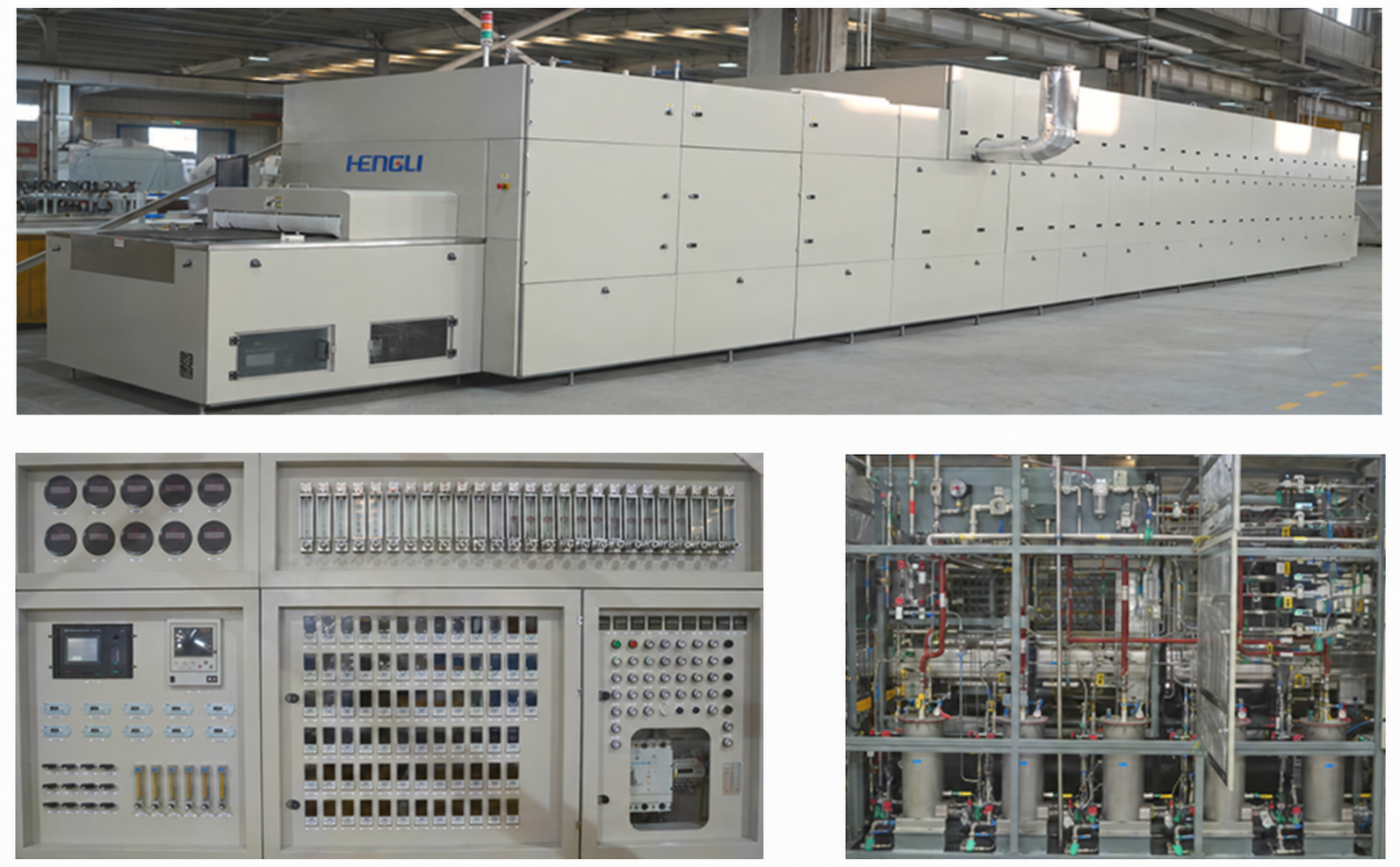
The HSA Series is XMZ’s controlled atmosphere belt furnace platform for continuous thermal processes requiring precise management of temperature, process gas and product cooling. These controlled atmosphere furnaces can be configured for nitrogen, hydrogen, nitrogen/hydrogen mixtures and other application-specific atmospheres, with gas distribution, atmosphere isolation, exhaust, oxygen monitoring and dew point control engineered around the process.
HSA controlled-atmosphere furnaces support processes including annealing, brazing, sintering, reduction, heat treatment, sealing and specialized electronic-material firing. Representative applications range from glass-to-metal sealing (GTMS), direct bonded copper (DBC) and copper thick-film or MLCC termination firing to metal processing, electronic packaging and other oxidation-sensitive or atmosphere-dependent thermal processes.
HSA is a configurable continuous atmosphere furnace platform rather than a single standardized furnace layout. Different materials and thermal processes can require fundamentally different combinations of peak temperature, residence time, atmosphere chemistry, gas-flow distribution, exhaust, oxygen or dew-point control, and cooling rate. XMZ develops each HSA configuration from the product, required temperature-versus-time profile, atmosphere, belt loading, throughput and facility requirements.
Typical HSA engineering capabilities include multi-zone temperature control, process-gas distribution, gas-tight furnace sections, atmosphere isolation, oxygen and dew-point monitoring, engineered exhaust, active cooling and application-specific controls. Furnace length, heated-zone arrangement, belt width, working height, gas system and cooling architecture can be configured around both development and production requirements.

When evaluating HSA as a hydrogen furnace, an oxygen controlled furnace or a high temperature belt furnace, engineering must define the gas-tight muffle requirements, multi-zone gas control and project-specific gas-safety arrangements.
HSA furnaces are built to the process rather than a fixed furnace layout. A system for copper thick-film firing may require precise oxygen control, while GTMS, DBC and brazing each require different heating, atmosphere and cooling arrangements. The examples below show representative HSA configurations developed for these processes.

A copper thick film firing furnace requires different atmosphere conditions through binder removal, high-temperature firing and cooling rather than one constant oxygen level throughout the process. HSA systems can combine a nitrogen base atmosphere with independently metered air addition, zoned oxygen measurement and feedback control, controlled exhaust, and atmosphere separation between process regions. The same controlled-atmosphere architecture can be configured as a copper paste firing furnace or an MLCC termination furnace.
MLCC termination firing process

A glass-to-metal sealing furnace must coordinate atmosphere, heating rate, sealing temperature, residence time, annealing and cooling around the glass and metal system. Depending on the materials and sealing process, an HSA GTMS furnace can be configured as a nitrogen atmosphere furnace or with hydrogen-containing N₂/H₂ atmospheres, dew-point control and additional gas monitoring and control. HSA systems can incorporate extended multi-zone heating, controlled gas distribution, sealing and annealing sections, and application-specific cooling to manage both the sealing cycle and subsequent glass stress.
Glass-to-metal sealing process

DBC furnace processing requires precise control of both temperature and oxygen concentration during copper-to-ceramic bonding. HSA direct bond copper furnace configurations can use nitrogen with metered air addition, zoned oxygen measurement and feedback control to maintain different atmosphere conditions through the heating and high-temperature sections. Multi-zone heating, distributed gas introduction and controlled cooling are configured around the DBC thermal profile, substrate and production requirements.

A controlled atmosphere brazing furnace must maintain the required atmosphere through heating, brazing and cooling to limit oxidation and support proper filler-metal wetting. HSA continuous brazing furnace configurations can operate with nitrogen, nitrogen/hydrogen mixtures or other process-specific protective and reducing atmospheres, depending on the base metals, filler alloy and brazing requirements. For hydrogen brazing furnace applications, gas distribution, atmosphere isolation, exhaust and safety controls are engineered around the process and hydrogen requirements.
Additional HSA applications: controlled-atmosphere annealing and metal heat treatment, reduction, selected controlled-atmosphere sintering, electronic packaging, hermetic processing and other specialty atmosphere processes.
Atmosphere performance depends on more than the bulk gas supplied to the furnace. HSA systems can be engineered with separate gas inlets, entrance and exit atmosphere barriers, zoned exhaust, process-gas preheating, oxygen sampling and application-specific flow distribution. These features manage gas composition and flow direction along the furnace while limiting outside-air ingress and unwanted interaction between process sections.
Depending on the process, an HSA may operate with dry nitrogen, hydrogen, nitrogen/hydrogen mixtures or deliberately controlled additions of another gas. Oxygen and dew point monitoring can be incorporated where these variables are critical. A low oxygen belt furnace is not necessarily designed to minimize oxygen everywhere; some processes require a controlled oxygen profile that changes along the thermal cycle.
Independent heating zones allow the HSA temperature profile to be developed around product heating rate, peak temperature, dwell time and cooling requirements. Zone length, heater arrangement, thermocouple layout and belt speed are selected together because product temperature depends on both furnace setpoints and residence time. Multi-point temperature control can be used in wider systems where the process requires tighter cross-belt control.
A controlled atmosphere annealing furnace may emphasize long residence time and controlled cooling, while GTMS, DBC and brazing configurations may use very different heating and cooling architectures. Temperature-uniformity guarantees therefore depend on belt width, loading, operating temperature, atmosphere and the selected furnace design rather than one universal HSA value.
Copper thick-film and MLCC termination processes can require carefully controlled oxygen concentration during binder removal and firing. The objective is not simply to minimize oxygen throughout the furnace: different portions of the thermal cycle can require different atmosphere conditions.
In one representative HSA architecture, multiple dry-nitrogen inlets are combined with independently metered micro-air addition, zoned exhaust and multi-point oxygen sampling. The early heating zones can operate with adjustable oxygen concentration while the high-temperature firing, free-cooling and cooling sections are maintained at very low oxygen levels. Measured oxygen concentration can be used within a feedback-based control strategy to adjust the atmosphere and maintain the required process condition.
Dry N₂ → Metered Micro-Air Addition → Process Zone → O₂ Measurement → Feedback / Control Adjustment
A representative HSA configuration uses multiple dry-nitrogen inlets together with independently metered micro-air addition, zoned exhaust and multi-point oxygen sampling. Oxygen concentration can be adjusted through the early heating zones while the high-temperature firing, free-cooling and cooling sections are maintained at very low oxygen levels. This provides a practical way to establish an atmosphere profile along the furnace rather than operating the entire system at one fixed oxygen concentration.

Conceptual control sequence, not a measured oxygen profile or a universal process recipe.
Certain glass-to-metal sealing processes require more than a conventional single-peak thermal profile. Depending on the glass composition, metal components and sealing requirements, the cycle may include a high-temperature sealing stage, an intermediate temperature reduction, a separate annealing stage and final controlled cooling.
HSA systems can be configured with two independently controlled heating sections separated by an intermediate cooling section. This dual-stage GTMS furnace architecture allows the sealing and annealing stages to be managed separately within one continuous production system and can avoid using an exceptionally long single heating platform to create both portions of the thermal cycle.

| Process Stage | Function |
|---|---|
| 1. Sealing Heating | Heat the assembly to the required sealing range under the selected controlled atmosphere. |
| 2. Intermediate Cooling | Reduce product temperature between sealing and annealing to establish the required thermal transition. |
| 3. Controlled Annealing | Establish the annealing temperature and residence time required for the glass-to-metal assembly. |
| 4. Final Cooling | Cool the product under controlled conditions selected for glass composition, geometry and residual-stress requirements. |
Cooling is part of the thermal process design. HSA systems can use free-cooling sections, gas cooling, water-cooled sections or combined arrangements according to the required product exit temperature and allowable cooling rate. Atmosphere protection can be maintained through cooling where oxidation must be limited.
Control systems can integrate multi-zone temperature control, belt-speed monitoring, gas-flow instrumentation, oxygen analysis, dew-point monitoring, alarms, recipe storage and data logging. Communication and automation interfaces can be provided for integration with upstream/downstream equipment and plant control systems when required.
| Parameter | Representative Capability |
|---|---|
| Process Atmosphere | N₂ • H₂ • N₂/H₂ mixtures • application-specific controlled atmospheres |
| Temperature Range | Application/configuration dependent; representative HSA platforms include systems in the ~1,150°C class, with selected higher-temperature designs |
| Conveyor | Continuous mesh belt; belt width and working height configured for product and load |
| Temperature Control | Independent multi-zone control; control-point arrangement depends on furnace width and process |
| Atmosphere Instrumentation | Flow control, oxygen monitoring and dew-point monitoring available as required |
| Cooling | Free cooling • gas cooling • water cooling • combined application-specific arrangements |
| Controls | Recipe/process control, alarms, data logging and plant-interface options |
A controlled atmosphere belt furnace continuously transports products through defined heating and cooling zones while maintaining a process atmosphere selected for the material and thermal cycle. HSA systems add application-specific gas distribution, atmosphere isolation, exhaust and monitoring to the continuous belt-furnace architecture.
HSA is the starting platform when the process requires nitrogen, hydrogen, controlled oxygen, dew-point management or another atmosphere that cannot be treated as normal air firing. HSK is primarily the air-atmosphere fast-fire platform.
Yes. HSA can be configured as a continuous annealing furnace for processes requiring a protective, reducing or otherwise controlled atmosphere. Heating length, belt speed, gas chemistry and cooling are selected from the material and required thermal cycle.
A representative approach combines a nitrogen base atmosphere with small metered additions of air, zoned exhaust and oxygen measurement at selected furnace locations. The required oxygen profile is process-specific; the entire furnace does not necessarily operate at one oxygen concentration.
For GTMS processes that require distinct sealing and annealing stages, an intermediate cooling section can separate two independently controlled heating sections. This provides more direct control over the sealing-to-annealing transition than a single long heating platform.
Key inputs include product/material, required temperature-versus-time profile, atmosphere composition and purity, oxygen/dew-point requirements, product dimensions and loading, throughput, belt or fixture requirements, desired exit temperature, utilities and facility constraints.
Send XMZ your product description, temperature profile, atmosphere requirements, loading method and target throughput. Our engineering team can review the process and recommend an HSA configuration including heating zones, atmosphere architecture, conveyor, exhaust and cooling.